Water mitigation in Chatham Hills comes down to three things happening in the right order: stopping the source, removing standing water, and drying the structure to a measurable target. Skip any one of those steps and the damage keeps growing in places you cannot see. When our crew arrives, usually within the first hour of your call, the first thing we do is identify the IICRC water category. Category 1 is clean water from a supply line or a refrigerator hose. Category 2 is grey water, which carries some contamination and might come from a washing machine discharge or a dishwasher overflow. Category 3 is black water, sewage or storm runoff, and it changes everything about how the job has to be handled. If you are dealing with a sewer backup, our sewage cleanup protocols include containment, antimicrobial application, and removal of porous materials that simply cannot be saved. We document the category on the first report because your insurance adjuster is going to ask, and the answer determines what coverage applies.
Extraction is the part most homeowners try to handle themselves, and it is where the most ground gets lost. A wet vac from the hardware store moves maybe a gallon or two before it needs to be emptied. Our truck-mounted and portable extractors pull hundreds of gallons per hour and reach deep into carpet pad and subfloor where surface water has already migrated. On a typical Chatham Hills basement flood we will pull between two hundred and eight hundred gallons before the drying phase even starts. Speed matters here because the longer water sits, the more it travels. Drywall wicks moisture upward at roughly one inch per hour for the first day, which is why baseboards often look fine while the wall behind them is already saturated twelve inches up. Hardwood flooring can cup within six to twelve hours of contact with standing water, and engineered planks delaminate even faster because the adhesive layer fails before the wood itself shows visible damage. Particleboard cabinet bases swell and lose structural integrity in under a day, which is why we move so quickly to lift toe-kicks and get airflow underneath before the damage becomes permanent.
How Structural Drying Actually Works
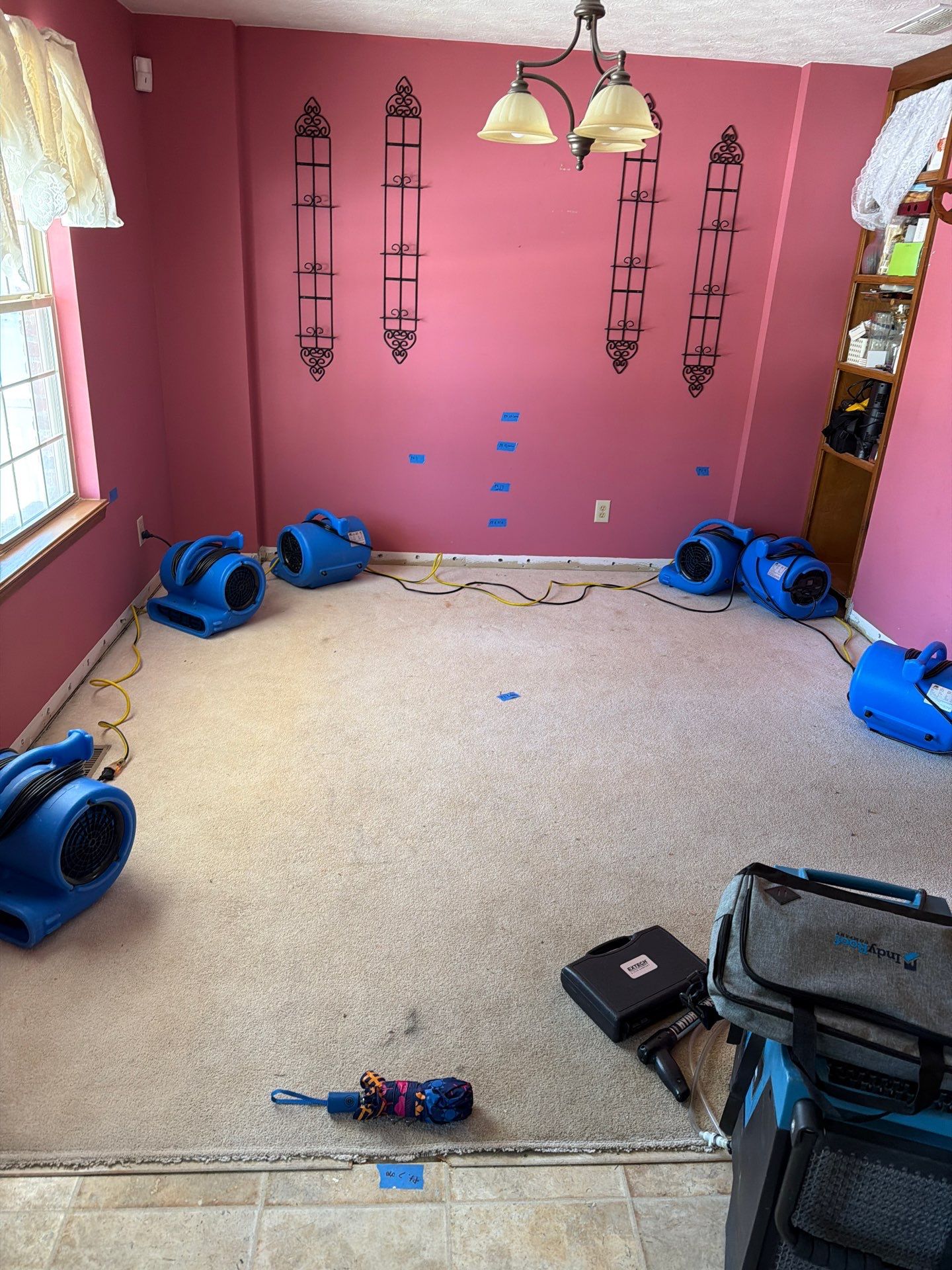
Once the standing water is gone, the real science begins. Drying a structure is not about pointing fans at wet spots and hoping for the best. It is about controlling temperature, humidity, and airflow inside a defined containment so that water trapped in materials evaporates faster than it can settle elsewhere. We set air movers at calculated angles, usually one unit per twelve to sixteen linear feet of affected wall, and we pair them with commercial dehumidifiers sized to the cubic footage of the space. A standard 1,200 square foot Chatham Hills basement might need four to six air movers and one or two LGR dehumidifiers running for three to five days. We log moisture readings on day one, day two, and every visit after that, comparing wet materials to a dry standard in an unaffected part of the home. When the numbers match, the job is done. Not before.
The math behind dehumidifier sizing is not arbitrary. Chatham Hills Water Restoration technicians calculate the grain depression needed to push humidity below the equilibrium moisture content of the wettest material in the space, and we adjust equipment placement daily as conditions shift. Cold weather in Chatham Hills actually slows evaporation because cold air holds less moisture, so in winter losses we often introduce supplemental heat to keep the drying chamber in the sweet spot of seventy to ninety degrees. In summer, the opposite problem appears, where ambient humidity outside the containment can creep back in through gaps in plastic sheeting and reset the work we just did. That is why we tape seams, seal returns on the HVAC system, and isolate affected areas from the rest of the house.
Hidden moisture is what separates a real mitigation company from a guy with a shop vac. We use thermal imaging cameras and penetrating moisture meters to find water inside wall cavities, under cabinet toe-kicks, and beneath flooring assemblies. If we find saturation behind drywall, we will often perform controlled cuts, sometimes called flood cuts, at the appropriate height to allow the cavity to dry from the inside. Our guide on water damage behind walls walks through exactly how we trace those hidden leaks and why surface drying alone is rarely enough on a Category 2 or 3 loss. Insulation is another quiet trouble spot. Fiberglass batts can look dry on the surface while holding water against the bottom plate of a wall for weeks, feeding mold growth long after the visible areas have dried. We pull and replace any insulation that shows elevated moisture, because trying to dry it in place almost never works.
What This Costs and How Insurance Handles It
Honest numbers matter when you are stressed. Emergency mitigation in Chatham Hills typically runs between $2,500 and $7,500 for a contained loss like a burst supply line, and $8,000 to $20,000 or more for a full basement flood with Category 3 contamination. Those ranges cover extraction, equipment placement, daily monitoring, antimicrobial treatment, and selective demolition of unsalvageable materials. They do not cover reconstruction, which is a separate phase with separate pricing. Most homeowner policies cover sudden and accidental water damage under Coverage A, and mitigation is almost always reimbursable because policies require you to take reasonable steps to prevent further loss. We document everything with photos, moisture maps, and Xactimate-formatted estimates that adjusters recognize. If you want a deeper look at pricing structure, our complete price breakdown covers line items in detail.
Flood damage from rising water or storm surge is a separate conversation entirely, because standard homeowner policies exclude it and you would need a National Flood Insurance Program policy or private flood coverage for reimbursement. We handle the documentation either way, and we work directly with adjusters from most major carriers in the Chatham Hills area so you are not stuck translating between us and them. When deductibles, depreciation, and coverage limits come into play, having an estimate written in the language adjusters expect speeds the claim along by days or sometimes weeks.
One thing worth saying plainly: not every wet floor is an emergency, and we will tell you when a fan and a window will do the job. A small refrigerator leak caught in the first hour might just need a couple of days of monitored drying. A second-story toilet that ran for six hours while you were at work is a different animal entirely, and that one needs us on site fast. The honest answer depends on the category of water, the time since the loss began, and the materials involved. Call us, describe what you see, and we will give you a straight read on whether you need a full mitigation response or just a careful eye.